
Outsourced lead generation is the use of an external sales development team to identify prospects, start relevant conversations, qualify interest and create a reliable flow of opportunities for an internal sales team. At its best, it gives a business more prospecting capacity, a repeatable operating rhythm and clearer pipeline data without waiting months to recruit every role in-house.
At its worst, it produces a large spreadsheet of weak names, damaged sender reputation and meetings that salespeople do not want to attend. The difference is not whether the team sits in your office. It is whether the operating model connects targeting, messaging, coaching, quality control and commercial accountability.
This guide explains what outsourced lead generation services should actually include, how to build a remote team at scale, how LATAM, the Caribbean, South America and South Africa compare, which metrics reveal real success, how to protect email deliverability and how to model cost without relying on a headline hourly rate.
What is outsourced lead generation?
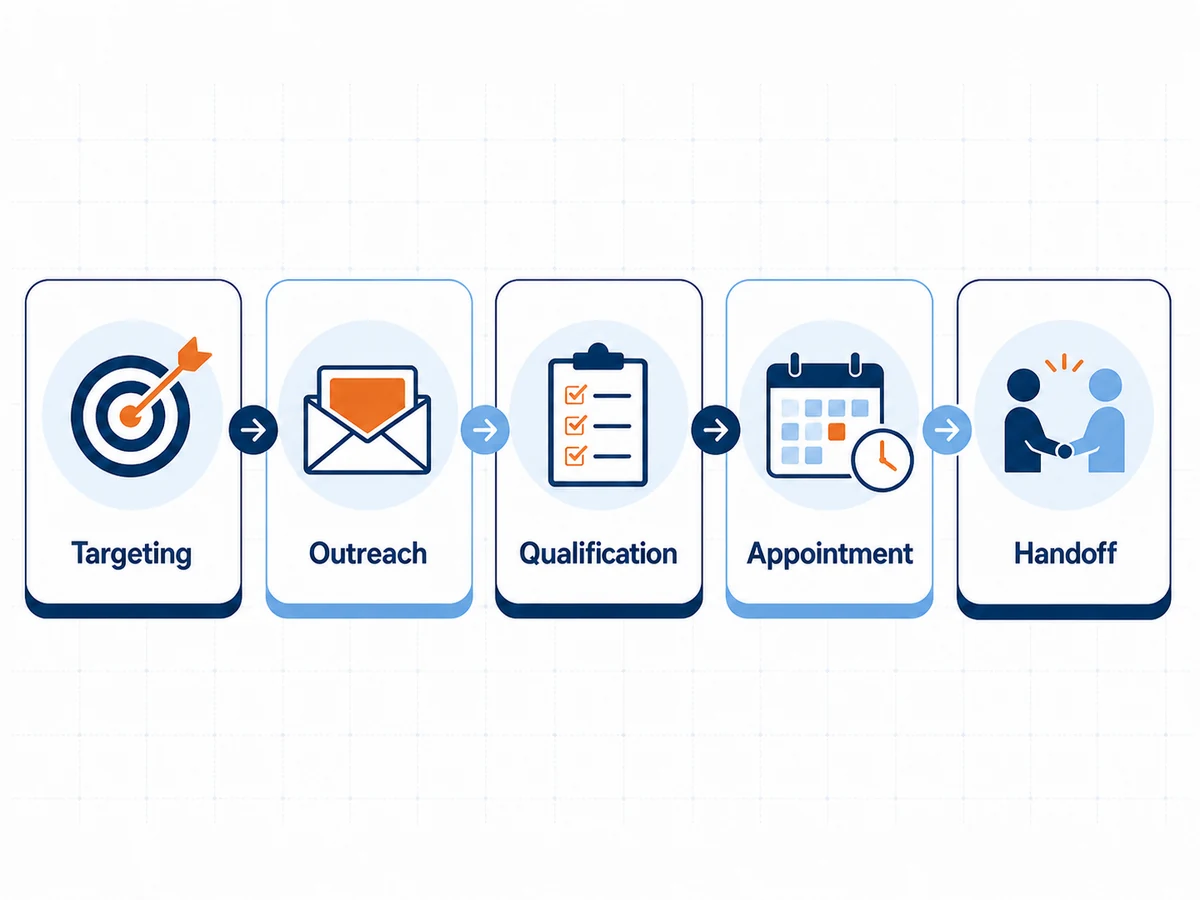
Lead generation outsourcing moves some or all of the prospecting workload to a specialist partner. The partner may provide researchers, sales development representatives, appointment setters, team leaders, quality analysts and campaign managers. The client should still own the offer, ideal customer profile, sales acceptance criteria and final commercial decisions.
The work can include:
- building and validating target-account lists;
- researching decision-makers and buying signals;
- outbound calling and follow-up;
- personalised email and LinkedIn outreach;
- inbound lead qualification;
- outsourced appointment setting;
- reactivating dormant prospects or customers;
- recording objections, competitor mentions and market feedback; and
- handing sales-ready opportunities to account executives with complete notes.
That makes an outsourced SDR team different from a list broker. A list is an input. Lead generation is a managed process that turns an agreed market into conversations, learning and qualified pipeline.
What should stay in-house?
Planning a controlled launch? Use our 90-day outsourced B2B lead generation pilot for US companies to turn these principles into a qualification charter, operating cadence and scale decision.
Outsourcing works when ownership is explicit. Your provider can run the prospecting engine, but your business should retain control of four decisions.
- Who is worth pursuing. Define the industries, company sizes, buyer roles, trigger events, exclusions and geographic limits that make up the ideal customer profile.
- What counts as qualified. A booked calendar slot is not automatically a qualified meeting. Agree the problem, authority, timing, fit and next-step evidence required for sales acceptance.
- What the brand can promise. Scripts should create useful conversations, not give an external team permission to invent pricing, capabilities or delivery commitments.
- How feedback changes the campaign. Sales must tell the outsourced team which meetings progressed, stalled or should never have been booked. Without that loop, volume rises while quality drifts.
If the handoff between marketing, the outsourced team and sales is unclear, outsourcing simply makes the confusion move faster.
A scalable outsourced lead generation team
A small pilot does not need a complicated hierarchy. It does need enough management capacity to stop each representative from becoming an isolated experiment.
A practical starting unit is three to six sales development representatives supported by a working team leader. Research and data work can be shared, while quality assurance and campaign management may begin as part-time responsibilities. As volume grows, those responsibilities should become named roles rather than invisible tasks left to whoever has time.
The operating rhythm matters more than the job titles:
- a daily check on data, activity blockers and live objections;
- weekly call calibration and message review;
- weekly sales-acceptance feedback from the client;
- fortnightly campaign decisions on segments, offers and channels; and
- a monthly commercial review linking activity to accepted pipeline and revenue.
This is how volume becomes useful. More dials or emails without better targeting and coaching only scale waste. A well-run outsourced sales team adds capacity while keeping the internal sales organisation close to the evidence.
Choosing between LATAM, the Caribbean, South America and South Africa
Location should follow the customer, channel and management model. These are delivery lenses, not quality rankings, and South America is considered separately here because individual countries can differ significantly from the broader LATAM proposition.
LATAM
LATAM is often attractive for North American campaigns because working hours overlap, Spanish and Portuguese capability is available, and travel can be more practical than with distant offshore locations. It can suit bilingual outreach, SaaS prospecting, inside sales outsourcing and programs that need frequent client interaction.
The diligence question is not simply whether a provider is in LATAM. It is which country and city, what English proficiency is required for the campaign, how competitive the local sales talent market is, and whether the provider can retain experienced representatives.
The Caribbean
The Caribbean can offer strong cultural and time-zone alignment with the United States, Canada and the United Kingdom, particularly for voice-led campaigns. English-speaking markets can work well for appointment setting, follow-up and blended customer acquisition programs.
Island markets vary in talent depth, infrastructure and cost. A credible plan should cover connectivity resilience, management capacity, recruitment lead times and how quickly another team can absorb work if a disruption occurs.
South America
South America is useful when a campaign needs specific Portuguese or Spanish markets, local commercial understanding or a delivery hub matched to US time zones. Colombia, Brazil, Argentina and other markets are not interchangeable. Language, labour regulation, wage inflation and the maturity of outbound-sales talent must be assessed country by country.
South Africa
South Africa has a mature business-process outsourcing sector, strong English-language capability and time-zone overlap with the United Kingdom and Europe. It can be particularly effective for complex conversations that need consultative selling rather than a narrow script.
For US coverage, shift design and management availability need closer attention. The right question is whether the strongest coaches and leaders will be present during the hours the campaign runs, not just whether agents can be scheduled.
For a wider comparison of delivery models, see onshore vs nearshore vs offshore outsourcing.
How much does outsourced lead generation cost?
There is no honest universal price because cost changes with location, seniority, channel mix, data requirements, technology, management ratio and commercial risk. Compare the total cost of a functioning team, not an agent rate.
Your cost model should include:
- recruitment and replacement;
- base pay, incentives and employment costs;
- team leadership and quality assurance;
- data sources and enrichment;
- dialler, CRM, email and conversation-intelligence tools;
- training and nesting time;
- management time retained by the client;
- compliance and security controls; and
- the cost of rejected meetings and wasted account-executive time.
An illustrative comparison makes the point. Suppose an in-house five-person SDR function costs $420,000 a year once salaries, employment costs, management, tools and recruitment are included. A managed remote model at $285,000 would show a $135,000 annual saving, or roughly 32%. That is not a market promise. It is the output of this formula:
Cost saving percentage = (fully loaded in-house cost − fully loaded outsourced cost) ÷ fully loaded in-house cost × 100.
Then test productivity. If the cheaper model creates fewer sales-accepted opportunities, the apparent saving may disappear. Cost per accepted opportunity is usually a better decision metric than cost per seat.
The metrics that define success
Activity matters, but it is diagnostic rather than decisive. A useful scorecard moves from inputs to commercial outcomes.
Data and coverage
- valid-contact rate;
- percentage of target accounts with the right buyer identified;
- duplicate and suppression rate;
- accounts attempted within the agreed cadence; and
- connect rate by segment, source and time of day.
Conversation and qualification
- positive conversation rate;
- lead-to-meeting rate;
- show rate;
- sales-accepted meeting rate;
- disqualification reasons; and
- time from first attempt to qualified handoff.
Pipeline and economics
- cost per sales-accepted opportunity;
- accepted opportunity-to-pipeline conversion;
- pipeline value created;
- opportunity-to-win rate;
- revenue influenced; and
- payback period.
Use funnel maths before launch. If a campaign starts with 10,000 valid contacts, reaches 8% in meaningful conversations, converts 6% of those conversations into held meetings and has 70% accepted by sales, the model produces about 34 accepted opportunities. Those are planning assumptions, not guaranteed success rates. Replace each assumption with observed campaign data as quickly as possible and model conservative, expected and strong scenarios.
This approach prevents a provider from celebrating 200 booked meetings when only a handful were appropriate. It also makes the relationship between better data, better conversations and eventual revenue visible.
Deliverability is an operating discipline
For email-led outbound lead generation, deliverability can fail before the offer is ever judged. A new team should not be allowed to send at volume from the main corporate domain on day one.
Protect the program by using authenticated sending domains, valid SPF, DKIM and DMARC records, carefully controlled volumes, verified addresses, clear opt-out handling and suppression lists shared across every tool. Monitor bounce rates, spam complaints and domain reputation by campaign and sending identity.
Google's email sender guidelines set authentication and spam-rate expectations for messages sent to Gmail accounts. US campaigns must also follow the FTC's CAN-SPAM requirements, while campaigns involving personal data in the European Economic Area require a lawful and documented approach under applicable privacy rules. Legal review should match the countries being contacted and the channels being used.
Deliverability is not a one-off technical setup. Data quality, copy, volume, recipient response and complaints affect it every day. One provider, one owner and one visible dashboard should control the full sending estate.

A 90-day launch plan
Days 1–15: define the commercial system
Agree the ideal customer profile, exclusions, offer, qualification definition, handoff, data sources, compliance controls and baseline economics. Review real won and lost deals before writing a script.
Days 16–30: recruit, train and rehearse
Train the team on the customer's world, not only the product. Representatives should practise opening calls, discovery, objections, voicemail, email follow-up and CRM notes. Managers should pass a calibration before coaching the team.
Days 31–60: run a controlled pilot
Limit the first campaign to a clear segment. Review call recordings and replies every day at the start. Change one meaningful variable at a time so the team can explain what improved the result.
Days 61–90: scale what has evidence
Add representatives, segments or channels only after data quality, sales acceptance and follow-up are stable. Document the playbook, set hiring triggers and agree the capacity of the internal sales team to receive more opportunities.
Our outsourcing implementation model is built around this sequence: discovery, design, controlled launch and accountable improvement.
Warning signs in a lead generation provider
Be cautious when a proposal guarantees a number of leads without defining qualification, prices only by activity, refuses access to recordings or campaign data, cannot explain its data sources, or treats booked meetings as finished work regardless of sales acceptance.
Also ask who will manage the team, how many representatives that person already supports, where data is stored, how opt-outs are synchronised and what happens when a campaign misses its assumptions. The strongest answer is a working operating model, not a promise that the provider has never missed.
Frequently asked questions
Is outsourced lead generation suitable for small businesses?
Yes, when the target market and offer are already reasonably clear. It is less suitable when the business has not yet learned who buys, why they buy or how a qualified opportunity should be recognised. In that case, begin with a small discovery-led pilot rather than a large team.
How many SDRs should we start with?
Three to six representatives is often enough to test a repeatable model while supporting real coaching and useful comparisons. A single representative can work, but the results are vulnerable to individual variation and absence. The right number also depends on how many opportunities the internal sales team can handle.
How quickly should outsourced lead generation produce results?
Early activity and conversation data should appear within weeks. Reliable conversion and pipeline evidence takes longer because prospects move through multiple stages. A 90-day pilot is usually more informative than judging the model on the first fortnight.
Is pay-per-lead the best pricing model?
Not automatically. It can align payment with volume while encouraging weak qualification or disputes about what counts as a lead. A managed-capacity model with agreed quality and pipeline measures often creates better operational behaviour.
What is the difference between lead generation and appointment setting?
Lead generation covers targeting, research, outreach, qualification and learning across the funnel. Appointment setting is the narrower step of booking a conversation. An appointment only becomes commercially useful when the prospect, need and next step meet the agreed acceptance standard.
The decision to make
Do not outsource lead generation simply to make prospecting cheaper. Outsource it when a specialist team can create more disciplined coverage, faster learning and scalable capacity while your business keeps control of targeting, qualification and revenue accountability.
If you want to model locations, team size, cost and a 90-day pilot around your current pipeline, book a discovery call with The Cattalyst.

About the author
Oliver Catt is the founder of The Cattalyst. He has spent 25 years inside contact centres, customer service, sales and training operations, and now helps organisations develop their leaders and build outsourced teams through a global partner network.
Start a conversation with Oliver