

If you are diagnosing an existing operation before changing suppliers, our 30-day contact center consulting audit for US teams provides a practical sequence for assessing demand, quality, capacity and leadership.
Outsourced customer service is the use of an external team to manage customer conversations on behalf of a business. That can include phone calls, email, live chat, social media, order support, billing enquiries, complaint handling, technical triage and overflow coverage.
It is often presented as a simple cost decision: compare an internal hourly rate with an offshore rate and choose the cheaper line. That is rarely enough. Customer service outsourcing changes who represents the brand, where customer data travels, how fast operational problems are noticed and who is accountable when demand or quality moves in the wrong direction.
Done well, outsourced customer support can extend opening hours, absorb seasonal volume, add specialist capability and build a flexible operation at lower total cost. Done badly, it shifts work without transferring the knowledge, leadership and controls required to perform it.
This guide explains what to outsource, how to compare LATAM, the Caribbean, South America and South Africa, how to calculate cost savings, which customer service metrics matter and how to launch without sacrificing trust.
What is outsourced customer service?
Customer service outsourcing transfers an agreed part of the customer journey to a specialist provider. The provider supplies people and day-to-day operations; the client retains responsibility for the brand promise, policies, customer outcomes and governance.
Common outsourced services include:
- inbound call handling;
- email and ticket support;
- live chat and social messaging;
- order, delivery and returns enquiries;
- billing and account support;
- technical-support triage;
- complaint handling and service recovery;
- customer onboarding or retention calls;
- after-hours and overflow coverage; and
- quality assurance, workforce planning and reporting.
The scope can be a dedicated team working only for one client, a shared team covering predictable low volume, or a blended model in which internal and outsourced teams use the same systems and standards.
What should you outsource first?
The right starting point is work that is frequent enough to design, clear enough to train and measurable enough to govern. It should also have a sensible risk profile.
Good candidates often include first-line order support, standard account enquiries, appointment management, overflow calls, email queues and after-hours coverage. These interactions create useful volume for training and performance analysis without immediately transferring the most sensitive or ambiguous cases.
Do not begin with a queue simply because it is painful. If the process changes every week, policies conflict or internal teams cannot agree what a good resolution looks like, the provider will inherit the confusion. Stabilise the process, document the decision rights and define escalation paths before moving volume.
Keep high-risk exceptions, regulated decisions and complex service recovery close to experienced internal owners until the outsourced team has demonstrated capability. The customer service outsourcing service should be designed around your customer journey rather than forced into a generic package.
How to build an outsourced support team at scale
A scalable team needs more than agents. It needs enough leadership, planning and quality capacity to keep service consistent as volume changes.
A practical operating structure may include frontline advisers, a working team leader, quality support, workforce planning and an operations manager. The exact ratio depends on complexity and maturity, but every responsibility should have a named owner from the start.
The management rhythm should include:
- intraday monitoring of demand, staffing and service levels;
- daily review of risks, backlogs and repeat contacts;
- weekly quality calibration using real interactions;
- weekly coaching based on a small number of behaviours;
- monthly capacity and forecast review; and
- a client governance meeting linking customer outcomes, root causes and commercial impact.
Scale in units that leaders can actually coach. Adding 30 advisers without adding experienced supervision may improve speed briefly while resolution quality and staff confidence fall. Capacity, leadership and knowledge must grow together.
Comparing LATAM, the Caribbean, South America and South Africa
There is no universally best location for outsourced customer service. The right choice depends on customer geography, language, channel, operating hours, data requirements and the complexity of each conversation.
LATAM
LATAM can provide useful time-zone alignment for North American customers and access to bilingual Spanish, Portuguese and English capability. It suits operations that need close collaboration with US-based client teams, extended daytime coverage and a growing pool of digital-support talent.
Assess the specific country and city. Recruitment depth, English proficiency, labour rules, wage movement, infrastructure and competition for experienced advisers vary significantly across the region.
The Caribbean
The Caribbean can offer cultural familiarity and time-zone alignment for US, Canadian and UK-facing voice operations. English-speaking markets are often well suited to customer care, reservations, financial-services support and blended sales-and-service conversations.
Business-continuity planning is essential. Review power and connectivity resilience, storm preparation, transport arrangements, alternative sites and the ability to shift work between teams. A smaller labour market can deliver excellent quality but needs realistic recruitment and growth assumptions.
South America
South America can be a strong option for Spanish- and Portuguese-language customer bases as well as selected English-language programs. Brazil, Colombia, Argentina and neighbouring markets each offer different cost, skill and regulatory profiles.
Choose at country level rather than buying a broad regional label. Verify local language capability, data-transfer requirements, management experience and the provider's record in the exact channel you intend to move.
South Africa
South Africa has an established contact-centre sector, strong English-language capability and useful time-zone overlap with the United Kingdom and Europe. It can work well for complex voice, customer retention, technical support and service-recovery conversations.
For North American coverage, examine shift design, staff transport and whether senior operational support is available during client hours. Customers experience the quality of the people who are actually on shift, not the provider's daytime leadership presentation.
Our guide to onshore, nearshore and offshore outsourcing provides a broader location decision framework.
How much can customer service outsourcing save?
Cost savings are real only when the comparison includes the complete operating model. An agent's wage is one line, not the cost of customer service.
Build both in-house and outsourced totals from:
- wages, benefits, overtime and incentives;
- recruitment, background checks and attrition;
- team leaders, quality, training and workforce planning;
- facilities, equipment, connectivity and software;
- implementation and knowledge-transfer time;
- client-side vendor-management capacity;
- security, compliance and audit work;
- rework, repeat contacts and escalations; and
- transition and exit costs.
Use the same formula for each scenario:
Cost saving percentage = (fully loaded current cost − fully loaded outsourced cost) ÷ fully loaded current cost × 100.
For example, if a 20-seat internal operation costs $1.25 million annually after management, tools, facilities and attrition are included, and the equivalent managed model costs $875,000, the modelled saving is $375,000, or 30%. This is an illustration, not a guaranteed benchmark. The next step is to stress-test it against quality and demand.
If first-contact resolution falls and repeat volume increases, a lower rate can create a higher cost per resolved enquiry. Compare cost per resolution, not only cost per contact or cost per seat.
The KPIs that protect customer experience
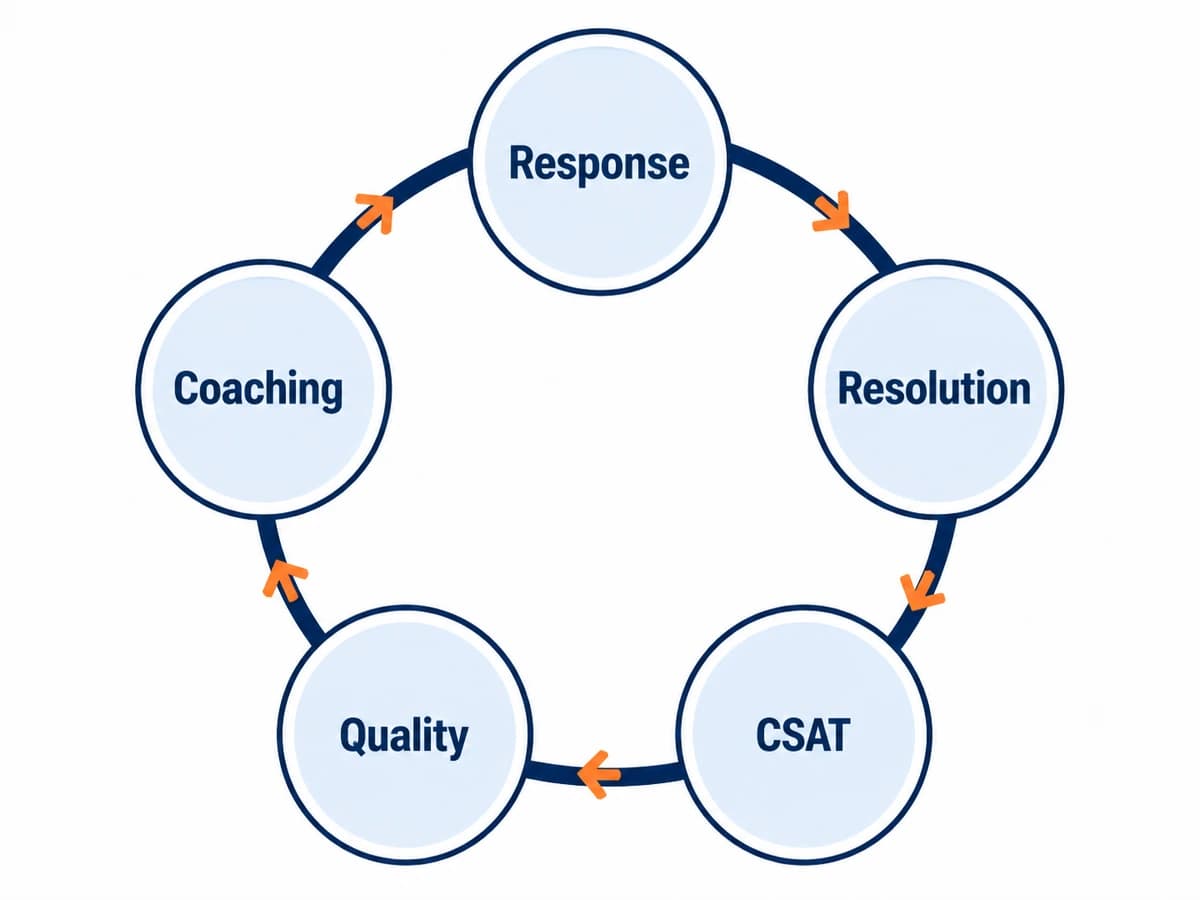
A strong scorecard balances access, quality, resolution, customer outcome, people and cost. No single metric is safe to optimise alone.
Access and demand
- service level and average speed of answer;
- abandonment rate;
- email or ticket backlog and oldest age;
- response time by channel;
- forecast accuracy; and
- schedule adherence.
Resolution and effort
- first-contact resolution;
- repeat-contact rate within an agreed period;
- transfer and escalation rate;
- average handle time, interpreted alongside quality;
- reopen rate for tickets; and
- customer effort score.
Quality and customer outcome
- quality-assurance score by behaviour;
- critical-error rate;
- customer satisfaction (CSAT);
- complaint and detractor themes;
- policy or compliance failures; and
- verified service-recovery outcomes.
People and economics
- absence and attrition;
- time to proficiency;
- coaching completion and behaviour change;
- productive occupancy;
- cost per resolved contact; and
- cost of repeat demand.
Success rates need a denominator and a definition. A 90% resolution rate means little unless everyone agrees what “resolved” means and how long the customer must remain contact-free. Track cohorts by contact reason, channel and customer segment so improvements are not hidden by a change in the mix of work.
Avoid using average handle time as a target on its own. Faster conversations can look productive while increasing transfers, repeat calls and customer effort. The most useful metrics are those that change a coaching decision, staffing decision or root-cause action.
Model productivity before promising savings
Turn the demand forecast into staffing assumptions before selecting a location or provider. For voice, begin with offered contacts, average handling time, arrival pattern, service goal, shrinkage and occupancy. For asynchronous channels, include concurrency, backlog tolerance and the time customers will wait for a complete answer.
An adviser with 7.5 paid hours and 30% shrinkage has about 5.25 available production hours before occupancy is considered. At 85% occupancy, that is roughly 4.46 hours of planned handling capacity. This simple calculation exposes why a quoted seat count cannot replace a workforce plan.
Then model three scenarios:
- expected demand with normal absence;
- peak demand with realistic shrinkage and slower handling; and
- disruption demand, including system failure or a product issue.
The outsourced team should show how staffing, overflow and escalation work in all three. Productivity is created by forecast accuracy, usable knowledge, sensible scheduling and capable leadership, not by pushing occupancy until advisers have no recovery time.
Knowledge, training and quality control
Most outsourcing failures described as “agent quality” begin earlier. The knowledge was incomplete, the training used presentation slides instead of real customer situations, or managers calibrated after customer complaints rather than before launch.
Build training around the work:
- customer journeys and contact reasons;
- systems and data handling;
- tone, judgement and brand boundaries;
- realistic simulations;
- supported live contacts during nesting;
- clear certification standards; and
- rapid feedback from quality and customer outcomes.
Quality forms should distinguish critical failures from coachable variation. A missing security check cannot be averaged away by a friendly greeting. Managers on both sides should score the same interactions until their interpretation is consistent.
If internal capability also needs strengthening, customer service training can align leaders and advisers around the same service behaviours.

Data security and compliance
Outsourced customer service often involves personal information, payment details, account access or recorded conversations. Map what data the provider can see, where it is processed, which systems store it and who can export it.
Controls should include least-privilege access, multifactor authentication, device and network standards, audit logs, incident response, retention rules, secure deletion, subcontractor visibility and periodic access review. Requirements should match the data and markets involved rather than rely on a generic certificate list.
For customers in the European Economic Area, the European Commission explains the roles and obligations involved in data protection under the GDPR. Other countries and industries impose their own privacy, recording, payment or health-data requirements. Obtain legal and security review for the actual scope before launch.
A 90-day customer service outsourcing plan
Days 1–20: discover and baseline
Map demand, contact reasons, channels, customer groups, systems, risk and current performance. Listen to real conversations. Record which problems the service team can solve and which require another part of the business.
Days 21–40: design and transfer knowledge
Agree the operating model, staffing assumptions, service goals, escalation rights, quality standards and governance. Build training from live examples and test system access before the first adviser needs it.
Days 41–65: pilot a controlled scope
Start with a defined queue, channel or customer segment. Keep expert support close, review quality daily and capture knowledge gaps as operational defects rather than blaming advisers for missing information.
Days 66–90: stabilise and scale
Expand only after staffing, resolution, quality, data handling and escalation are stable. Compare customer outcomes with the baseline and publish a joint improvement plan for the next quarter.
The outsourcing implementation process should make each of these decisions visible before volume moves.
Questions to ask an outsourcing provider
Ask who will lead the operation, how many people that leader already supports, how forecasts become schedules, how knowledge changes reach the floor and how client and provider quality teams calibrate.
Then ask for the uncomfortable evidence: attrition by program, examples of failed launches, incident-response timings, business-continuity test results and the actions taken when customer satisfaction fell. A credible provider can explain what it learned, not merely present its best month.
Commercially, confirm what is included in the rate, how overtime and training are charged, what happens when volume misses the forecast, who owns licences and data, and how the relationship can exit without losing customer history.
Frequently asked questions
Will outsourced customer service damage our brand?
It can if the provider receives a script without the context, authority and coaching needed to use judgement. It should not if brand standards, decision rights, quality calibration and customer feedback are built into daily operations.
Which customer service channels can be outsourced?
Phone, email, live chat, social messaging, tickets and back-office follow-up can all be outsourced. Choose channels based on process maturity, data risk and management capacity rather than moving everything at once.
How long does implementation take?
A narrow, well-documented pilot can launch in several weeks. Complex regulated work, new technology or large-scale recruitment takes longer. A provider that promises speed should show which discovery, testing and certification steps it is compressing.
What is a good customer service success rate?
There is no universal percentage. Define success by contact reason: resolution without repeat contact, acceptable quality, customer outcome, compliance and cost. Compare the outsourced result with your own baseline and an agreed improvement trajectory.
Should we choose nearshore or offshore customer service?
Choose according to customer hours, language, complexity, data, management overlap, resilience and total cost. Nearshore often improves collaboration and time-zone alignment; offshore can provide deeper scale or different cost structures. Provider capability matters more than the label.
The decision to make
Outsourced customer service should make the operation more capable, not simply more distant. The business case is strongest when the model improves coverage, resilience and access to talent while protecting resolution quality, customer trust and management visibility.
If you want to compare locations, costs and a phased transition using your actual contact volumes, talk to The Cattalyst about a practical outsourcing plan.

About the author
Oliver Catt is the founder of The Cattalyst. He has spent 25 years inside contact centres, customer service, sales and training operations, and now helps organisations develop their leaders and build outsourced teams through a global partner network.
Start a conversation with Oliver